523 Genealogy Websites for UK and Irish Research, Checked and Sorted
Most of the people who order a chart from me are still researching when they first arrive. The Genealogy Resources Directory is the list I wished they had: every county record office, every family history society, the free indexes and the tools, sorted by nation, type and cost, with the dead links taken out. This is what it covers and how to get the most from it.
What is in it
The directory holds 523 websites, each with a one-line description, its type, the region it covers, a cost label and a direct link. They fall into thirteen types. The two biggest, archives and societies, are the ones that matter most for six-generation research, because that is where the records that never reached the big platforms are kept.
| Type | Entries | What you will find |
|---|---|---|
| Archives & record offices | 183 | Every county record office in England and Wales, the Scottish regional archives, PRONI and the Republic's national archives, and the Irish county heritage centres. |
| Family history societies | 95 | County and regional societies, one-name and special-interest groups, the national bodies. |
| Free records & indexes | 49 | FreeBMD, FreeREG, FreeCEN, online parish clerk projects, local BMD indexes, gravestone and war memorial transcriptions. |
| Blogs | 45 | Working genealogists and archivists who write regularly about British and Irish sources. |
| Research tools | 43 | Date calculators, map collections, surname distribution, palaeography and Latin help, parish locators. |
| Software & apps | 21 | Desktop programs and online tree builders that export a GEDCOM file. |
| Podcasts, video & courses | 20 | Listening and learning, from the national archives' own channels to independent shows. |
| Newspapers, military & migration | 17 | Digitised newspapers, service records, medal rolls, passenger lists and emigration sources. |
| DNA | 13 | Testing companies and the third-party tools that make sense of the matches. |
| Records & family tree sites | 11 | The big platforms: Ancestry, Findmypast, FamilySearch, MyHeritage, TheGenealogist and their kin. |
| Newsletters & magazines | 10 | Print and email titles worth the subscription. |
| Forums & communities | 8 | Where to ask a question about a county, a surname or a record. |
| Directories & link libraries | 8 | The other lists: GENUKI, Cyndi's List and the like. |
On cost, 317 of the 523 are free. The rest are labelled freemium (32), subscription (42), membership (99), pay as you go (7) or paid (26). Treat the label as a rough guide: most archives are free to search and charge only for copies, and a society's membership usually unlocks indexes that are free to members and unavailable to anyone else.
One kind of site is deliberately absent. Chart-printing and chart-design services are not listed, because they compete with the studio that publishes the directory, and a list that quietly favoured its own trade would not be worth trusting. Everything else that helps British and Irish research is eligible.
Seven views, one for each nation
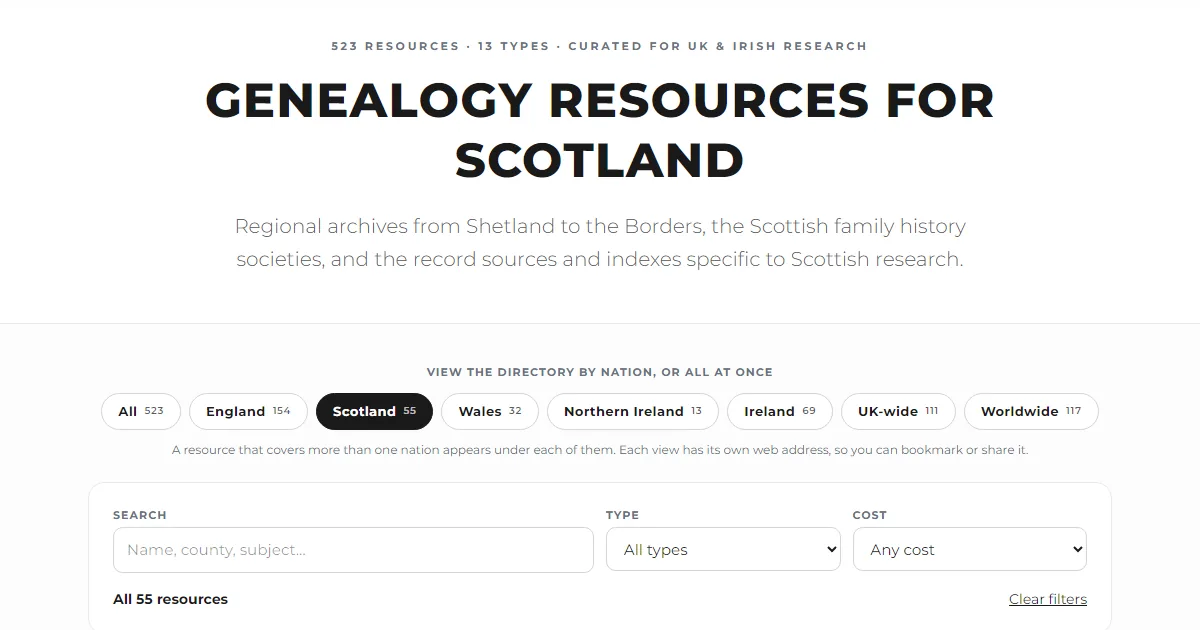
British and Irish research is regional. A Yorkshire family and a Kerry family need almost none of the same websites, so the directory can be viewed by nation, and each view is its own page with its own address that you can bookmark or share. A resource that covers more than one nation appears under each of them, which is why the counts add up to more than 523.
| View | Entries | Emphasis |
|---|---|---|
| England | 154 | Every county record office, the county societies, the local BMD and parish register indexes, the online parish clerks. |
| UK-wide | 111 | The National Archives, the free record projects, national societies, research tools, blogs and podcasts, plus the Channel Islands and Isle of Man. |
| Worldwide | 117 | The global platforms, DNA tools, software, and the national archives of the USA, Canada, Australia and New Zealand for tracing emigrants. |
| Ireland | 69 | The free civil records and censuses, the Catholic parish registers, Griffith's Valuation, the county heritage centres and Roots Ireland. |
| Scotland | 55 | ScotlandsPeople and the National Records of Scotland, the regional archives from Shetland to the Borders, the Scottish societies with their gravestone transcriptions. |
| Wales | 32 | The National Library of Wales, the county archives, the free Welsh newspapers, and the societies that cope with patronymic surnames. |
| Northern Ireland | 13 | PRONI, GRONI, the six-county archives and societies, and the Ulster-wide sources that also cover Donegal, Cavan and Monaghan. |
How it was built, and why the links can be trusted
The list began as a spreadsheet of 564 sites compiled in September 2026 from the sources my own customers use, the standard reference lists, and the county-by-county sweep that any serious British researcher ends up doing. Then every address was tested. A first pass fetched all 564; a second followed redirects and tried the obvious variations of any that failed; a third read the page that came back, because a site can answer "OK" and still be an empty server, a parked domain or a page that has been hijacked to sell something unrelated.
That work flagged 34 entries: dead domains, a defunct online parish clerk project whose old address now serves casino advertisements, council archive pages that had moved without a forwarding address, and a well-loved newsletter whose site had gone. Twenty-one were given new addresses, each checked in a real browser before it went in, and thirteen were removed. The result was 523 entries that worked on the day of publication.
They are kept working by an automated check that runs on the first of every month, tests every link, and reports anything broken, unreachable or moved to a different site. A link that fails in two consecutive checks is fixed or removed. Sites that refuse automated visitors but open normally in a browser, and there are a couple of dozen of those, are checked by hand.
A route through it for a beginner
If you have a name, a rough date and a county, this order gets you furthest with the least money spent.
- Start in the free indexes for the nation. Choose the nation view, set the cost filter to Free and the type to Free records & indexes. For England and Wales that means FreeBMD for civil births, marriages and deaths from 1837, FreeREG for parish registers and FreeCEN for census returns. For Scotland it is ScotlandsPeople, free to search. For Ireland it is the civil records, the 1901 and 1911 censuses and the Catholic parish registers, all free.
- Find the county's record office. Set the type to Archives & record offices and type the county into the search box. The record office catalogue tells you which parish registers, wills, poor law and estate papers survive for your parish, and most now sell copies or images online.
- Join the county society. Type Family history societies. For the price of membership you get indexes nobody else has, a journal that answers questions before you ask them, and people who know the parish.
- Go to the big platforms with a target. By now you know which records you need. A subscription is money well spent when you are looking for a known parish and decade, and wasted when you are browsing.
- Use the tools for the hard parts. The Research tools type has palaeography and Latin help for early registers, date calculators for ages at death, parish locators for finding the neighbouring church, and historical maps for the places that no longer exist.
Using the filters well
The search box matches names, descriptions and regions at once, so "Yorkshire" finds the record offices, the societies and the indexers for the county in one list. Type and cost narrow it further. The filters stay with you when you switch nation, and they are written into the page address, so a filtered view can be bookmarked or sent to someone: a link to the free Welsh indexes, say, or every Irish society.
Each entry shows its region label as written by the source, which is often more specific than the nation: a county, a city, a diocese. When a county's record office serves two historic counties, both are named.
What the directory is for
A six-generation circular chart has room for 63 ancestors. Nobody starts with all of them, and the chart does not need all of them, but every one you can add is a line that means something to the person who receives the print. The directory exists to shorten the distance between a half-filled tree and a full one, using the same sources I would use myself. When the research has gone as far as it will, the chart is the reward for it.
Subscribers to The Genealogy Times, the studio's monthly newsletter, also receive the whole directory as an Excel spreadsheet with a clickable link for every entry. The download link appears when the subscription is confirmed and comes with each emailed edition.
Frequently asked questions
Is the Genealogy Resources Directory free?
Yes. The directory is free to browse with no sign-up. Each entry carries a cost label describing the resource itself: 317 of the 523 are free to use, the rest are freemium, subscription, membership or pay-as-you-go.
How often are the links checked?
Every address was checked by hand and by script before publication in September 2026, and an automated check re-tests all 523 links on the first of each month. Anything broken, unreachable or moved is reviewed and fixed or removed.
Why are some well-known genealogy companies missing?
Chart-printing and chart-design services are left out because they compete with the studio that publishes the directory. Every other kind of genealogy resource is eligible, including the large commercial record platforms.
Can I download the directory?
Subscribers to The Genealogy Times, the studio’s monthly newsletter, receive the whole directory as an Excel spreadsheet with a clickable link for every entry. The download link is shown when a subscription is confirmed and is included in each emailed edition.
How do I suggest a resource or report a dead link?
Use the contact form. Council archive addresses change often, so reports are welcome; corrections are usually made the same day.
Read next
Start with the directory
Open the Genealogy Resources Directory →Research done? See the 72 chart designs.